
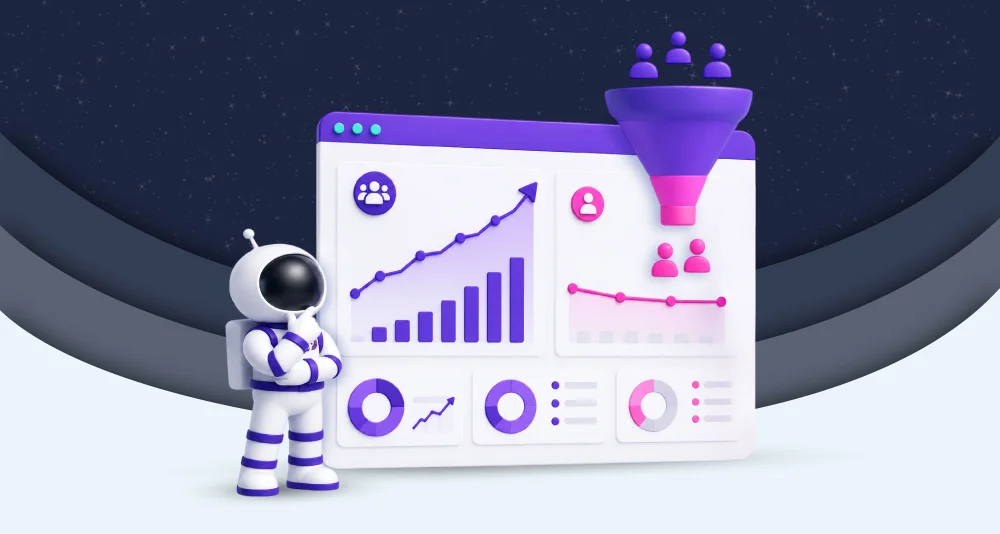
Why Your Website Gets Traffic But Fails to Generate Leads
For many businesses, increasing website traffic feels like progress.
Many businesses see visitor numbers rise, search visibility improve, and marketing activity generate more traffic, but still struggle to increase enquiries.
It is a common situation. Businesses invest significant time and budget into attracting more visitors, only to find that lead generation stays exactly where it was before. The assumption is often that more traffic will naturally lead to more enquiries. In reality, traffic and lead generation are two different things.
A website can attract thousands of visitors every month and still struggle to generate meaningful opportunities. The issue is very rarely visibility; more often, it comes down to what happens after somebody arrives.
Traffic is not the same as intent
One of the biggest misconceptions in digital marketing is that all traffic carries equal value.
A visitor arriving on a website after searching for a specific solution is very different from somebody reading a general industry article. Both count towards traffic figures, but only one is likely to become a lead.
This distinction is important because many traffic growth strategies focus on volume rather than intent.
A business may successfully attract visitors through broad informational content, industry news or educational resources. While these pages can support visibility and brand awareness, they do not always connect directly to a commercial need.
As a result, visitor numbers increase while lead generation remains unchanged.
The question is not simply how many people are visiting a website; it’s whether the right people are visiting and whether the website helps them move towards a decision.
Too many websites assume visitors already understand the value
Business owners and internal teams spend every day immersed in their products, services and industry. Over time, it becomes easy to assume that visitors share the same understanding.
They do not.
Many websites explain what a business does without clearly communicating why it matters.
Visitors arrive looking for answers to specific challenges. They want to understand whether a company can solve their problem, what makes the solution different and why they should take the next step.
When those answers are difficult to find, people leave.
This does not always happen because the content is poor. Often, there is simply too much information competing for attention. Technical explanations, company history, service descriptions and supporting content all fight for space, while the core message becomes diluted.
Clarity remains one of the most important factors in website performance; businesses that communicate value quickly tend to generate stronger results than those that attempt to explain everything at once.
Visitors need direction
A surprising number of websites place the responsibility for navigation on the visitor.
People are presented with multiple menus, numerous service pages, large amounts of content and several possible next steps; the expectation is that they will work out where to go.
Most do not.
Visitors make decisions quickly; they want clear pathways and obvious actions.
The strongest websites guide people through a journey. They help visitors understand where they are, what information is relevant and what step should come next.
When that structure is missing, engagement drops. People browse, consume information and leave without taking action. This creates the illusion that traffic is the problem when the real issue lies in conversion.
Trust is overlooked
Lead generation is not only about visibility or usability.
Trust plays a significant role in whether somebody chooses to make contact.
Many websites invest heavily in design and content but provide limited evidence to support their claims.
Visitors want reassurance; they want to know who they are dealing with and whether others have achieved positive outcomes.
Case studies, client testimonials, measurable results and examples of previous work help build confidence.
Without these elements, even highly relevant visitors may hesitate to enquire.
This becomes particularly important for businesses selling complex services, larger projects or solutions that involve significant investment.
People don’t make those decisions based on promises alone.
Mobile experience influences conversion
Website traffic continues to shift towards mobile devices across most industries.
Yet many businesses still evaluate their websites primarily from a desktop perspective.
A website may look excellent on a large screen while creating friction on mobile:
- Navigation becomes more difficult.
- Forms become harder to complete.
- Page speed slows.
- Content feels overwhelming.
Small usability issues have a cumulative effect.
Visitors never contact a business to explain why they left; they simply leave.
This is one reason why lead generation and traffic figures often tell different stories.
Businesses see growing visitor numbers but fail to recognise the experience many of those visitors are having once they arrive.
Better lead generation starts with understanding behaviour
When traffic grows without an increase in enquiries, the immediate reaction is often to focus on attracting more visitors.
That approach can work, but it doesn’t address the underlying issue.
A more valuable exercise is understanding how people interact with the website today.
- Where do visitors enter the site?
- Which pages receive attention?
- Where do people leave?
- What information appears to influence decision-making?
Answering these questions provides far more insight than traffic figures alone.
Lead generation is not simply a marketing challenge; it is a combination of messaging, user experience, structure, trust and conversion strategy.
How We Approach This
At purpleplanet, we don’t look at lead generation problems as a traffic problem.
In many cases, businesses already have visitors arriving on their website. The challenge is helping those visitors understand the value of the service, build confidence in the business and take the next step.
That is why we focus on more than the design of the website alone. Every project starts with understanding the business, its audience and the actions the website needs to support. From there, we look at messaging, structure, user experience and conversion opportunities to make sure the website is working as a commercial tool rather than simply an online brochure.
Increasing traffic can be valuable, but it only delivers results when the website is capable of converting that attention into meaningful enquiries.
We believe websites should help businesses communicate more clearly, create confidence and make it easier for prospective customers to take action.
If you are attracting visitors but not generating the enquiries you expect, we are always happy to have a conversation about where the gaps may be and what improvements could make the biggest difference.